

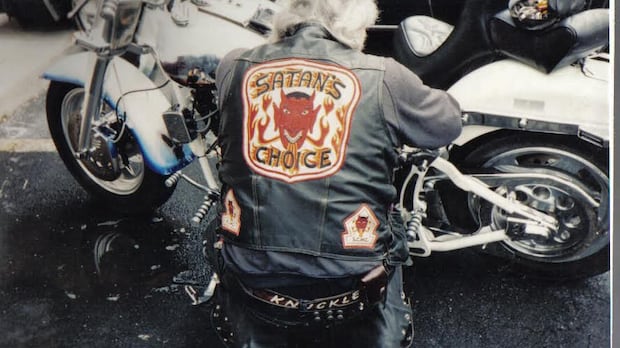
Police remain vigilant for an outlaw motorcycle gang that once dominated the streets of northern Ontario and appears to be making a comeback.
Surveillance by the Ontario Provincial Police (OPP) is due to increased activity by Satan's Choice as several other motorcycle gangs continue to operate chapters in the North.
“Whenever an outlaw motorcycle gang appears, we take note of it and we want to know: 'Is this going to be a problem? Is there going to be violence? Is there going to be criminal activity associated with this?'” said Detective Inspector. Scott Wade of the Ontario Provincial Police Motorcycle Unit.
The unit, in operation for approximately 30 years, works with police forces across Ontario and around the world to combat outlaw motorcycle gangs.
“We've seen the Hells Angels and other outlaw motorcycle gangs involved in everything from white collar to blue collar, homicide, human trafficking, importing, exporting, drug trafficking, and violence is one of their tools of trade,” Wade said.
The cLub's story

Before being absorbed by the Hells Angels in what is known in the biker world as a “patch-over” in the early 2000s, Satan's Choice was considered one of the most powerful biker gangs in Ontario.
Satan's Choice has always been an all-Canadian club and its leader was former international boxer Bernie Guindon.

Guindon would serve almost 15 years in prisonfirst for indecent assault on a minor then for drug trafficking.
Last August, a former member of the Hells Angels – and Guindon's son, Harley – announced on social media that he had revived the club and planned to open chapters across Canada, including in northern Ontario.
Harley also did several stays behind bars.
In 2007, he was convicted of assault and battery, false imprisonment and extortion with a firearm, and sentenced to five years in prison.
In 2012, Harley was involved in Project Kingfisher, an operation by the Ontario Provincial Police's Motorcyclist Enforcement Unit in conjunction with local police. He was arrested for drug trafficking.
In northern Ontario, one of the most well-known clashes between Satan's Choice and law enforcement took place in December 1996. A bomb exploded in an alley next to the Sudbury police station. No one was hurt, but the explosion blew a hole in the wall.
Two members of Satan's Choice were convicted of making the bomb and a Sudbury biker was found guilty of obstructing justice.

The main suspect, Michael Dubé, a member of Satan's Choice in Sudbury, committed suicide in prison while awaiting trial.
Police said the station was targeted after members of the gang were refused entry to a local strip club, leading to a confrontation with officers. The bomb was originally intended for the club, but was redirected to the police station at the last minute.
OPP monitoring possible turf war
Social media posts show new Satan's Choice chapters popping up in cities like Sudbury, Thunder Bay, Oshawa and Hamilton.

Det. Insp. OPP Wade confirmed several outlaw motorcycle gangs operate in the north.
He explained that outlaw motorcycle gangs tend to be more active in larger northern centers and can be found in cities like Sudbury, Sault Ste. Marie, Timmins and North Bay.
Wade said police were aware of the resurgence of Satan's Choice and the potential for conflict with rival clubs.
“We will prioritize our priorities as needed,” he said. “If there is violence – especially violence affecting the public – the police will be everywhere.
“My suggestion would be that our motorcycle gangs would like to avoid this attention so that they can carry out their crimes underground in peace. So, overall, I would say we are well prepared to curb violence if it breaks out.”
He said outlaw motorcycle gangs often recruit new members to the criminal underground by targeting a specific area and identifying someone who is active in crime in that area. Family and friends of current members are also often targeted.
“Outlaw motorcycle gangs have a one percent mentality, meaning they are the one percent of society that doesn't respect and conform to society's rules or laws. It's something they wear proudly on their vest.”
He added that these groups will also seek to recruit like-minded people.
“We see the patches. I mean, we know that they're going on rides and having events, as well as they're involved in the crimes that we're investigating,” Wade said.
He stressed that not everyone who wears a patch or vest is part of an outlaw motorcycle gang.
“It’s when they use that patch to commit crimes, when they use that patch as a show of power to claim an area and territory and then commit crimes in that area.”
Motorcycle gangs often sell merchandise — like patches or other supporting gear — depicting their respective logos, which Wade said people view as as innocuous as wearing a shirt to support a local sports team, without understanding the real risks.
“We've had instances where … members of the public were wearing supportive shirts, sweaters or jackets, and they were violently attacked because of it,” Wade said.
“When you wear something like this, know what you are doing and know the risk you are taking, and also that you are supporting organized crime with your purchase.”
Looking at the national situation

Across the country, law enforcement agencies are seeing similar trends.
Sgt. Ryan Ferry of the Edmonton Police Service has over 20 years of experience fighting gang-related crime.
He also serves as the Western Director of the National Organization for Gang Information and Awareness, a nonprofit network that brings together police officers, educators and policy experts to share intelligence and best practices on gang activity nationwide.
Ferry said outlaw motorcycle gangs — often called OMGs — remain a national police priority.
“They are very widespread and their presence is well established in almost all provinces of the country,” he said. “Law enforcement considers outlaw motorcycle gangs a major threat to public safety. »
Ferry said outlaw motorcycle gangs are distinguished from recreational riding clubs by their structure, criminal ties and reliance on fear and intimidation.
“Threats of harm and creating an atmosphere of fear, intimidation and violence — that’s what sets them apart from people who just enjoy riding motorcycles.”
He explained that depending on the region, motorcycle gangs are linked to a wide range of criminal activities, including “human trafficking, drug trafficking, firearms trafficking and economic crimes of all kinds.”
Ferry said these relationships often extend to street and neighborhood gangs – something that is becoming increasingly common in provinces like Ontario.
“We are finding more and more frequently that there is indeed both a social and criminal link with other criminal networks.”
A dangerous way of life

Ferry said many people underestimate the dangers of associating with outlaw motorcycle clubs, confusing the lifestyle with harmless rebellion.
“We want people to understand that outlaw motorcycle gangs are a very unique group of people who certainly perpetuate crime and violence. And people who get involved with these gangs put themselves at risk of getting drawn into some of that crime and violence.”
He added that these groups are not themselves immune to violence.
“Despite media portrayals that outlaw motorcycle gangs and bikers are big, bad and tough, they also have their own enemies. And we've heard that directly from some of them,” Ferry said.
“We see examples and stories of stabbings or firearms attacks,” and “the use of incendiary devices and explosives against personal or club property.”
Ferry said people attracted to the social side of biker culture — the ideas of liberty and brotherhood — can easily get caught up in criminal networks.
“We have seen time and again people get stuck in this social side and then become victims of extortion or threats, or be used by individuals in these clubs to promote the goals and criminality of these clubs.”
Ferry said most people who join the biker lifestyle end up regretting it.
“The vast majority of people I've talked to at one point or another end up hating this lifestyle,” he said.
“They either become broke, or they become paranoid, or they lose friends along the way, or law enforcement eventually catches on to their criminality, or they alienate their friends or family. It's a very harsh lifestyle.”
