

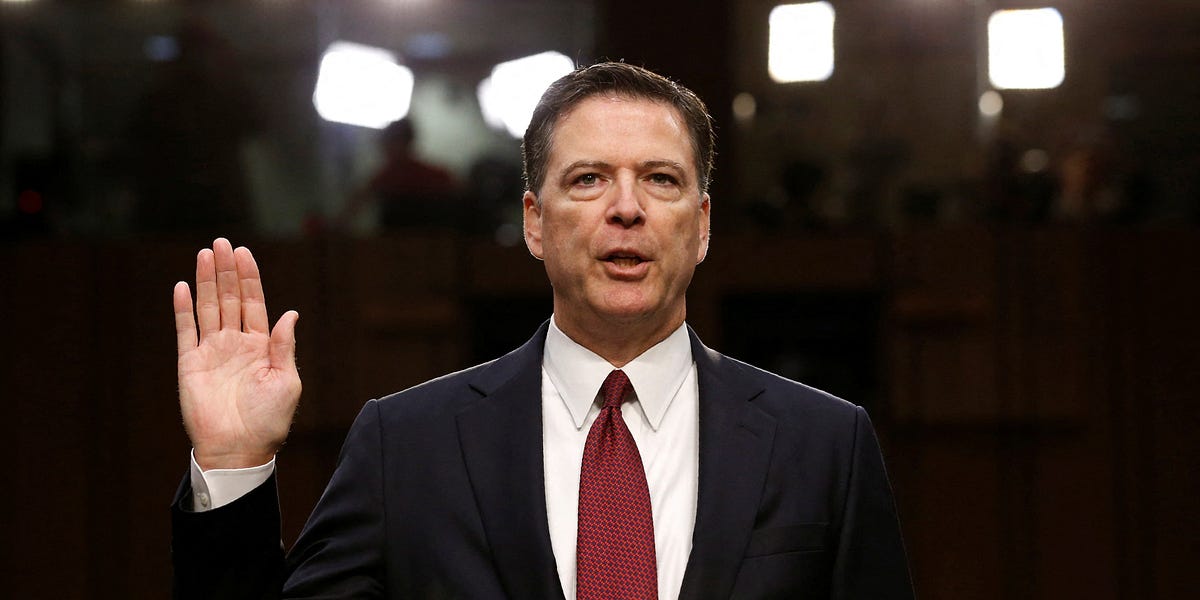

James Comey, former FBI director (Jonathan Ernst/Reuters)
On Monday, Federal District Court Judge Cameron Currie dismissed indictments against former FBI Director James Comey and New York Attorney General Letitia James. Judge Currie found that Lindsey Halligan's appointment as Acting U.S. Attorney in the Eastern District of Virginia was illegal and, therefore, the indictments she obtained were invalid. This was just one of many problems with the Comey prosecution, as noted in my last post:

You can read Judge Currie's opinion dismissing Comey's case here.
Judge Currie dismissed the indictments without prejudice, meaning that in theory the government could re-indict the cases once a legally appointed U.S. Attorney is in place. In Comey's case, however, the statute of limitations expired just days after he was indicted. There is a federal law, 18 USC 3288which gives the government six months to re-indict a case if it is dismissed after the statute of limitations has expired. But as Judge Currie explained in footnote 21 of his opinion, this principle does not apply where, as here, there was never a legal indictment in the first place. That means the statute of limitations should prevent prosecutors from obtaining a new indictment.
The government can and almost certainly will appeal Judge Currie's decision. But if his firing stands, it appears the Comey case will be closed for good. (The way the government charged the James case should not have the same statute of limitations problem.)
In some ways, this is the least embarrassing outcome for Halligan and the government. This avoids legal conclusions about vindictive prosecutions and all the misconduct by Halligan and the FBI discussed in my last post; there is no reason for the judge to rule on these motions now that the case is dismissed. The government can string this together in a lengthy (and probably ultimately unsuccessful) appeal while blaming another “deep state activist judge” and put aside all its other serious problems in this case.
It would have been gratifying to see legal findings on vindictive prosecutions and government misconduct, to see the government held accountable. But of course, if you're Comey, a win is a win and you'll gladly take it.
When this decision came down, I was working on an article for The Atlantic on how the criminal justice system is an effective check on Trump's power. He talked a lot about the Comey accusation. It was originally scheduled for after Thanksgiving, but in light of the Comey news, the editors decided to update the article and publish it immediately – which is how I spent my Monday afternoon. I want to share a free link with you all.
Trump's power remains limited – The Atlantic
As I've written before, I think results like this are hopeful reminders of the limits of Trump's power. As the holidays approach, we all need some hopeful news.
I wish you and yours the happiest of Thanksgivings.
All my best wishes,
Randall
