

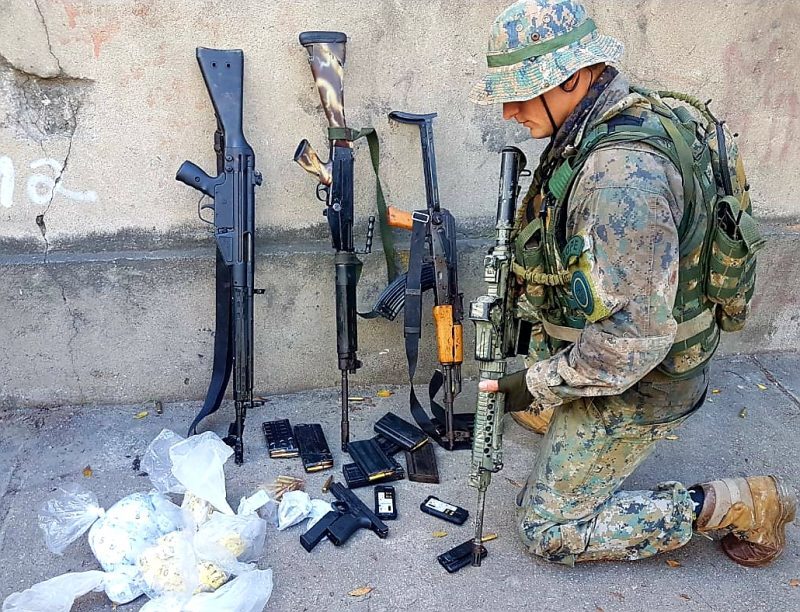
A recent extremely deadly anti-gang raid in Rio de Janeiro highlights both the growing firepower of Brazilian gangs and the growing challenge authorities face as criminal groups diversify their weapons supplies.
Rio de Janeiro police carried out a violent raid on October 28 that killed around 130 people, and it is the deadliest operation ever carried out in the city against organized crime. Police seized at least 90 rifles during this incident, almost twice as many as the 47 recorded the whole month of September in Rio.
This recent case is part of a broader trend of increasing weapons seizures, as Brazilian criminal organizations expand their rifle arsenals and diversify their methods of acquiring firearms. Production of improvised rifles, or “ghost guns,” is on the rise.
Trends in the use of military firearms by Brazil's criminal organizations are the focus of a recent academic study article “Indiscriminate shooting: The rise of military-style firearms amid regulatory failures and data gaps in Brazil,” published in the Journal of Illicit Economies and Development, by Bruno Langeani and Natalia Pollachi.
In addition to an increase in artisanal and illegal production of military-grade weapons in the country, the authors reported changes in the modus operandi around weapons acquisition. The authors analyzed the data to identify failures in information collection by Brazilian authorities and highlighted recent and relevant improvements in security strategies.
InSight Crime spoke with Langeani about gun trafficking routes, ghost guns and policies to address the problem.
SEE ALSO: Arms trafficking case puts Europe-Paraguay pipeline on the map
InSight Crime (IC): Southeastern Brazil, which includes the states of São Paulo, Rio de Janeiro, Minas Gerais and Espírito Santo, plays a central role in arms trafficking routes. Why did you decide to focus on this specific region?
Bruno Langeani (BL): We decided to focus on the southeast for two reasons. The first is methodological, because we have been studying the gun market for some time and know how problematic and fragile the data is. We therefore had to select a single region of Brazil to analyze.
But the other motivation was contextual: Southeast Brazil is the region that seizes the most firearms and is the headquarters of the country's two largest criminal organizations – the First Command of the Capital (Primeiro Comando da Capital – PCC), of São Paulo, and the Red Command (Comando Vermelho – resume), from Rio de Janeiro.
And even though military-style weapons do not represent the majority of weapons seized in Brazil, we decided to analyze these weapons with greater firepower, as they are crucial for allowing criminal groups to expand their control. Gangs use these types of weapons not only to commit crimes such as bank robberies and executions, but also in operations to expand their territory.
IC: In the article you also analyze ghost guns (i.e. homemade or improvised firearms), mentioning that they began to be seized more frequently in Brazil around 2017. What explains the arrival of ghost guns in the country at this specific time?
BL: 2017 was a year of widespread expansion of organized crime and gang warfare. Brazil was the scene of huge rebellions, frequent territorial conflicts and deaths in conflicts between criminal groups. The result was a significant increase in demand for guns from gangs.
But at that time, criminals had no good local alternatives to obtain guns: gangs had to either bribe a public official or turn to the foreign market, which made the weapons expensive. So they started looking for alternatives. Homemade weapons had the advantage of being cheaper, untraceable and made from parts that were easier to obtain, particularly on the American market.
Currently, we believe ghost guns are on the rise as the number of improvised weapon seizures increases relative to the total number of guns seized. In addition, the operating mode of production is evolving. In the past, guns were made domestically with parts from the United States. But from 2023, clandestine factories began to appear and produce rifles on an industrial scale, with much more modern machinery, such as 3D printers.
In addition to allowing a much higher number of rifles to be manufactured in a shorter time frame, this new method does not depend on external parts, because the criminals produce everything in factories and the weapons are more durable and accurate than those produced at home.
IC: You mention that Brazilian authorities focus too much on incidents involving the possession and carrying of weapons, but not on combating the trafficking and production of improvised weapons. What are the positive elements of existing policies and what should change to increase the effectiveness of the state's response to this problem?
On a positive note, we have seen some states create specialized police stations to combat arms trafficking. There, they work on more in-depth intelligence reports and can identify most gun sources in the state.
This is important because even when considering a relatively small region like the Southeast, traffic dynamics are very different from state to state, so you cannot apply diagnostics from state to state without assessing specific conditions. Authorities should adapt their policies according to traffic dynamics, paying increased attention to specific borders linked to local routes, for example.
But some political aspects still need to be improved. Brazilian policies aimed at combating arms trafficking are still in their early stages of development. We therefore do not yet have structured measures to resolve this problem. And even with progress, the study of dynamics either does not exist or is imperfect in some cases. When addressing this topic, authorities generally do not have data on what is entering the market or the percentage of ghost guns. They often don't even know that homemade submachine guns exist.
We recommend strengthening the federal police tracking center, which is responsible for monitoring routes. In addition to directly seizing weapons, they also support states in regional seizures. Considering that Brazil seizes approximately 100,000 weapons per year, we believe this center would need to be much larger to handle the volume of trafficking.
SEE ALSO: OAS report outlines short-term strategies to limit arms trafficking in Latin America
IC: How could investments in data collection help solve the problem and drive more effective policies?
BL: One of our main accomplishments with this article was cleaning up and organizing erroneous data due to poor quality and recording issues. We spent at least eight months resolving these issues, which would be simple for the authorities to resolve. Standardization of data and increased training of police officers responsible for registering seized weapons, as well as greater integration between officers on the ground and those producing intelligence reports, would help resolve problems related to data collection.
Procedures such as reporting identified attempts to erase the weapon's serial number, the absence of a weapon identification number or the fact that it appears to be a homemade weapon would be very easy to implement, but the police do not seem to care about this.
If police had better data, they would be able to detect and manage these dynamics much more quickly, and it would be easier to coordinate effective interventions.
*This interview has been edited for clarity and flow.
Featured image: Weapons seized by Rio de Janeiro Military Police in 2018. Credit: Rio de Janeiro Military Police.
