

Washington warns of the increase in violent transnational gangs and estimates that MS-13 has reached a record level with 10,000 members
The Trump administration has reported an increase in violent transnational gangs in the United States, particularly against Mara Salvatrucha, also known as MS-13, which also has ties to the Central America Northern Triangle organization. Although US President Donald Trump has approached this issue in a demagogic manner, criminalizing immigration and ignoring the fact that this organization originated in Los Angeles, California, the Federal Bureau of Investigation (FBI) claims that these organizations are recruiting more young people than ever before and demanding more violent behavior from their members. American authorities believe that these gangs are partially controlled from El Salvador, although this hierarchy is not as clear.
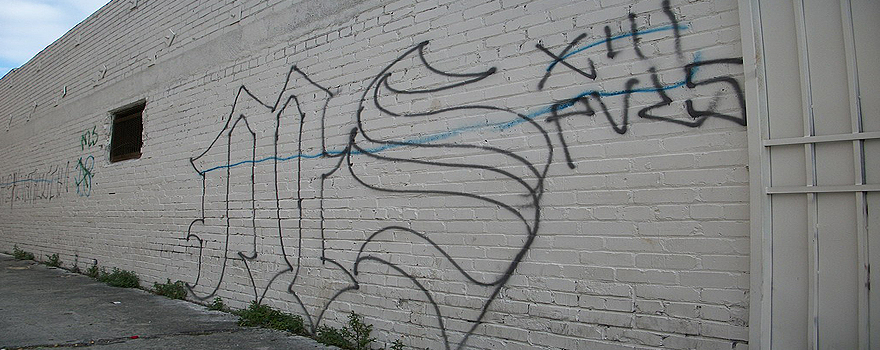
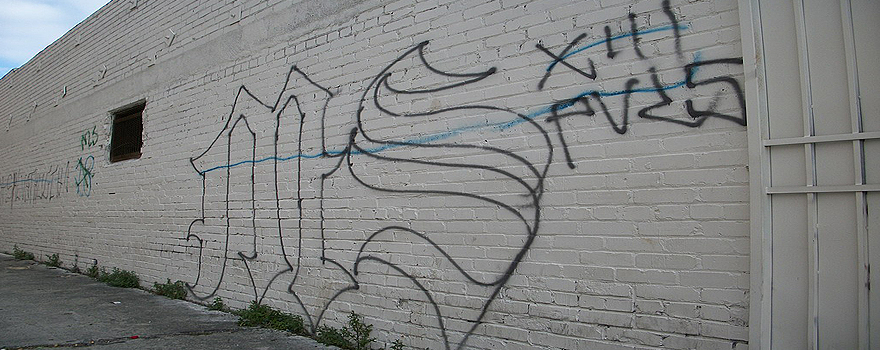
▲Graffiti by Mara Salvatrucha (Wikimedia Commons)
ARTICLE / Lisa Cubías (spanish version)
Probably the pronunciation of the word “animal” has never provoked so much controversy in the United States, such as President Donald Trump's reference to MS-13 gang members on May 16, 2018. Initially, this appeared to be a reference to all undocumented immigrants, thus causing immediate and widespread rejection; it was later clarified that the address referred to gang members entering the United States illegally to commit acts of violence. Trump has framed his already declared war on gangs as part of his zero-tolerance immigration policy and strengthening domestic agencies, such as Immigration and Customs Enforcement, to reduce immigration flows from Latin America to the United States.
The description of the gang phenomenon presented by Latin American youth as a migration issue had already surfaced in President Trump's State of the Union address on January 28, 2018. Before the US Congress, he shared the story of two American teenagers, Kayla Cuevas and Nisa Mickens, who were brutally murdered by six members of the MS-13 gang while returning home. He claimed the perpetrators took advantage of loopholes in immigration law and reiterated his position that the U.S. Congress must address those loopholes in order to prevent gang members from entering the United States through them.
Despite Trump's demagogic simplification of the problem, the truth is that such organizations were born in the United States. They are, like The Washington Post said, “as made in the USA as Google.” They originated in Los Angeles, California, initially due to Mexican immigration, then the arrival of immigrants and refugees from the armed conflicts taking place in Central America. During the 1980s, El Salvador experienced the rise and fall of twelve years of civil war between the government and left-wing guerrilla groups. The scale and brutality of the conflict, as well as the political and economic instability that the country was experiencing, caused an exodus of Salvadorans to the United States. The flow of youth from El Salvador, Honduras, and Guatemala propelled the rise of Mara Salvatrucha, also known as MS-13, and the 18th Street Gang, both linked to the already existing Mexican Mafia (The M).
When peace returned to Central America in the 1990s, many of these young people returned to their home countries, either to follow their families or to be deported by U.S. authorities due to their continued criminal activities. This is how gangs began their criminal activity in the Northern Triangle, where to this day they continue to be a critical social problem.
Transnationality
According to the U.S. Department of Justice, there are approximately 33,000 violent street gangs, with a total of 1.4 million members. MS-13, with around 10,000 young people enlisted, represents 1% of the total figure and in 2017 only 17 members were indicted, and still deserves the full attention of the White House. Apart from the possible political interests of the Trump administration, the truth is that the American authorities have highlighted its increase and its danger, in addition to declaring that certain orders are given from El Salvador. Such transnationality is seen in an alarming light.
The United States does not recognize MS-13 as a terrorist organization because it is not on their list. National strategy to combat terrorismpublished in October 2018. It is rather classified as a transnational criminal organization, as mentioned a document issued by the US Department of Justice in April 2017. According to the report, several of its leaders are imprisoned in El Salvador and send representatives illegally crossing into the United States to unify gangs operating on American territory, while forcing US-based MS-13 gangs to return their illegal profits to gang leaders in El Salvador and inciting them to exert more control and violence in their territories.
According to the FBI, MS-13 and 18th Street »continue to expand their influence in the United States.” These transnational gangs “are present in almost every state and continue to increase in number, now targeting young recruits more than ever.” The U.S. Attorney General warned in 2017 that these numbers were “up significantly from just a few years ago.” “Transnational criminal organizations like MS-13 represent one of the most serious threats to American security,” he said.
Stephen Richardson, deputy director of the FBI's Criminal Investigation Division, told Congress in January 2018 that the mass arrests and imprisonments of MS-13 members and middle leaders over the past year in the United States have frustrated MS-13 leaders in El Salvador. “They are very interested in sending younger, more violent offenders into this country through their channels to serve as enforcers for the gang,” he told the House Homeland Security Committee.
The transnational nature of MS-13 is contested by the expert Roberto Valencia, author of articles and books on the maras. He works as a journalist at El Faro, one of the leading investigative digital media outlets in El Salvador; his latest book, entitled Map of Zacatraz (Letter from Zacatraz), was just published a few months ago.
“At first, the Los Angeles gangs served as moral guides to those returning to El Salvador in the 1990s. Some of the veteran leaders living in El Salvador today grew up in Los Angeles and retained personal and emotional ties to the gang structures in which they were enlisted,” Valencia told Global Affairs. “However,” he says, “this does not imply an international connection: everyone, regardless of where they live, believes that they are the essence of the gang and are not subordinate to the organization of someone else's country.” “They share a deeply personal relationship and it doesn't dissolve that easily, but the bond as an organization was severed a long time ago,” he sums up.
Valencia firmly rejects any interference by the United States' MS-13 chapter in that of El Salvador. Instead, he admits that there could be some sort of reverse influence, in that Salvadoran gang members in the United States “may be deported to El Salvador and end up in Salvadoran prisons, where they can be punished by prison mafias.”
Migrants: cause or consequence?
Roberto Valencia also addresses President Trump and his references to gangs: “Trump talks about MS-13 to win votes under the premise of a migration policy that ends up criminalizing every immigrant. It is outrageous that Trump presents them as the cause, when the gangs actually started in the United States. In fact, the vast majority of immigrants from the Northern Triangle arrive in the United States to escape the gangs.”
In Central America, the control gangs exert over low-income territories ranges from demanding “rent” for businesses located in their areas, to coercing and threatening old women to care for unregistered newborns, and “asking” young girls to act as the gang's main girlfriend or be killed along with their family. The demand for young girls is an extremely common cause of migration, which also reflects the misogynistic culture of rural areas of Latin American countries.
The majority of President Trump's remarks described MS-13 as a threat to public safety and the stability of American communities. Nonetheless, the Center for Immigration Studies, a leading independent, nonprofit research organization, has conducted research into the impact of MS-13 in the United States and what immigration actions the administration should take to control their presence. He classifies MS-13 and other gangs as a threat to public safety, sharing President Trump's view. However, his view is not influenced by the political landscape and refers specifically to gangs only; no mention of regular immigrants or those traveling in recent caravans is made and linked to criminal activity of this impact.
Greg Hunter, American criminal lawyer and former member of the Arlington County Bar Association Board of Directors from 2002 to 2006 and active member of the Criminal Justice Act Committee of the United States District Court for the Eastern District of Virginia from 2001 to the present, has worked closely with gang-related criminal cases and says cases related to shoplifting and illegal immigration are far more common than those categorized as threats to public safety or the “American community,” such as drug trafficking and murder. He also alluded to the fact that these organizations are not centralized and operate under the same identity and yet do not follow the same orders. Efforts were made to centralize operations, but proved ineffective.
It is crucial to consider statistical trends on the influx of immigrants in the face of recent immigrant caravans leaving the Northern Triangle, which have emerged as a recent focal point of discussion in the gang debate. Upon announcing their departure to the United States, President Trump labeled all of the immigrants in the caravans as “ruthless criminals,” essentially contradicting previous records from U.S. Customs and Border Protection. In his Safety report for 2017it depicts a total of 526,901 illegal immigrants denied entry, of which 310,531 were apprehended and 31,039 arrested. Among the arrested immigrants, there were only 228 members of MS-13 (there were also 61 members of the 18th Street gang). Instead, the caravans are made up of diverse citizens fleeing the violence caused by MS-13 in the Northern Triangle, rather than gang members seeking to expand their criminal activities toward the United States.
