

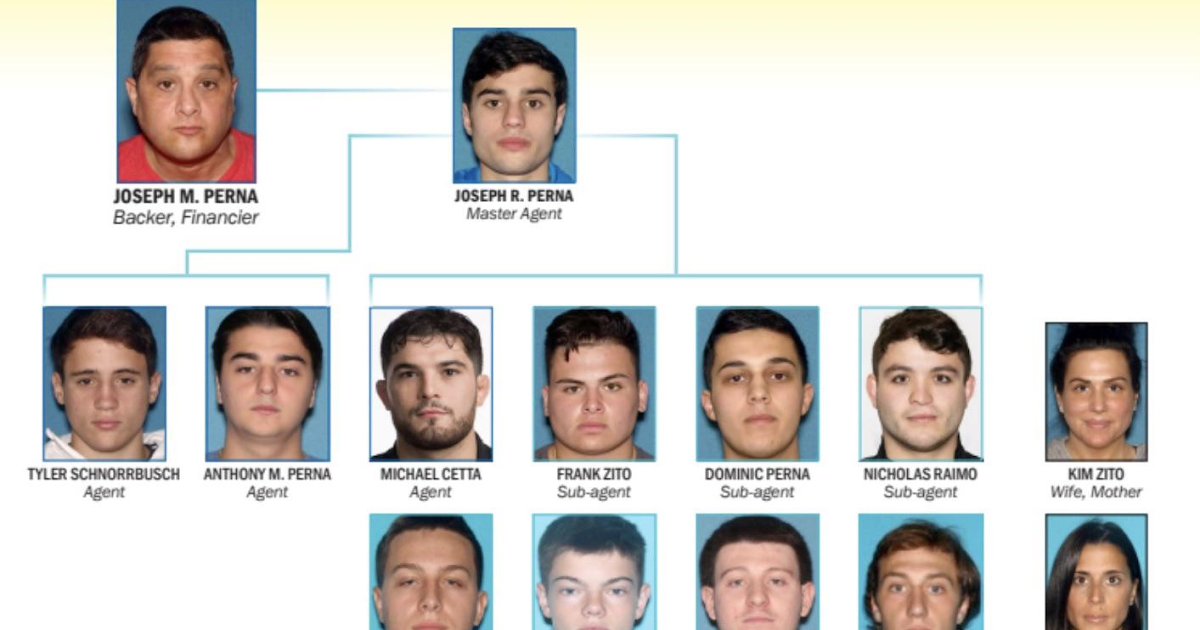

A mob member ran a multimillion-dollar sports betting ring by recruiting a network of Generation Z bookmakers through his son's circle of friends, which included college athletes, New Jersey law enforcement said Thursday.
Authorities said Joseph M. “Little Joe” Perna of Fairfield, New Jersey, who they said was part of the Lucchese crime family, financed the operation with his son, Joseph R. Perna, 25, handling the day-to-day business.
In total, law enforcement arrested and charged 14 people, including Mr. Perna's wife, ex-wife, another son and a stepson. The names of the two people charged match those of former Rutgers wrestlers.
The defendants are accused of racketeering, conspiracy, gambling offenses and money laundering.
It is unclear who Joseph M. Perna, 55, represented. Anthony Iacullo, the lawyer for the younger Mr. Perna, who pleaded not guilty during a virtual court appearance on Thursday, said his client would contest the charges.
“Joseph looks forward to confronting the false allegations against him in court,” Mr. Iacullo said in an email.
The charges follow recent indictments by federal prosecutors in Brooklyn that have brought new scrutiny to how gambling has affected sports in the United States. Two of those cases involved insiders who placed bets using nonpublic information on NBA and MLB games, according to federal prosecutors in the Eastern District of New York.
It remains unclear to what extent college sports are involved in the charges announced Thursday.
New Jersey Attorney General Matthew J. Platkin said the operation included a “number” of college athletes, without specifying how many or which schools. Some of the defendants appeared to have loose ties to each other since high school and were not college athletes.
Gambling is a major concern for many involved in college sports, which in recent years has been supercharged by payments to players. Last week, the NCAA announced that six former men's basketball players from Mississippi Valley State, the University of New Orleans and Arizona State had engaged in “gambling-related game manipulation.”
The NCAA recently approved a rule that would allow student-athletes to bet on professional sports, but delayed its implementation in the face of criticism. Three members of Congress wrote a letter to the NCAA last month asking the body why it allowed student-athletes to bet on sports. In their letter, the lawmakers cited the federal indictments in Brooklyn. The rule could now be repealed.
On Thursday, Mr. Platkin said at a news conference that the betting operation took place even though sports betting is legal in the state.
“Organized crime families seem to be having a hard time breaking this old habit, so we’re going to break it for them,” he said.
He said the operation used offshore websites, tricking people into placing bets amounting to about $2 million in illegal transactions over two years. He relied, he said, on younger players recruited from Mr. Perna's high school and college friends.
The biographies of two of those charged, Michael Cetta, cousin of the younger Mr. Perna, and Nicholas Raimo, match those of former wrestlers at Rutgers University. Mr. Cetta, 23, and Mr. Raimo, 25, are accused of being “agents” of the company.
A lawyer for Mr. Cetta declined to comment, and it was not clear who represented Mr. Raimo. Kevin Lorincz, a Rutgers spokesman, said the school “does not comment on law enforcement matters.”
In New Jersey, the accusations are particularly resounding. A state law led to a landmark Supreme Court decision in 2018 that paved the way for widespread legalization of sports betting across America.
Gambling companies argued that legalization brought gambling out of the underworld and allowed it to be regulated. But critics have countered that legal betting often leads to illegal betting and that the excess of betting opportunities has increased opportunities for corruption.
Younger men, like those charged Thursday, are particularly at risk of becoming problem gamblers, experts say. According to studies, sports bettors are typically men under the age of 35, and the risk of gambling addiction is disproportionately high among young adults.
Four years after the Supreme Court's decision, the American Gambling Association wrote to the Justice Department saying that illegal gambling was still pervasive throughout America.
“A large illegal sports betting market continues to exist via offshore sites, which have established well-known brands,” the letter said, adding that they “enjoy numerous competitive advantages that allow them to offer better odds and promotions and ignore any commitment to responsible gaming.”
Mr. Platkin asked any students listening to take note that while they can play on their phone if they are of age, “You should not play as part of a mob-supported operation. This is free parental advice.”
Brian J. Neary, the attorney for Tyler Schnorrbusch, a recent college graduate charged in the scheme, described his client as a “promising young man.” Mr. Schnorrbusch, 23, has pleaded not guilty.
Mr Neary said he was skeptical of the government's claims. “Students,” he said, “can’t compete with FanDuel.”
https://www.nytimes.com/2025/11/13/nyregion/new-jersey-sports-gambling-mob.html
