

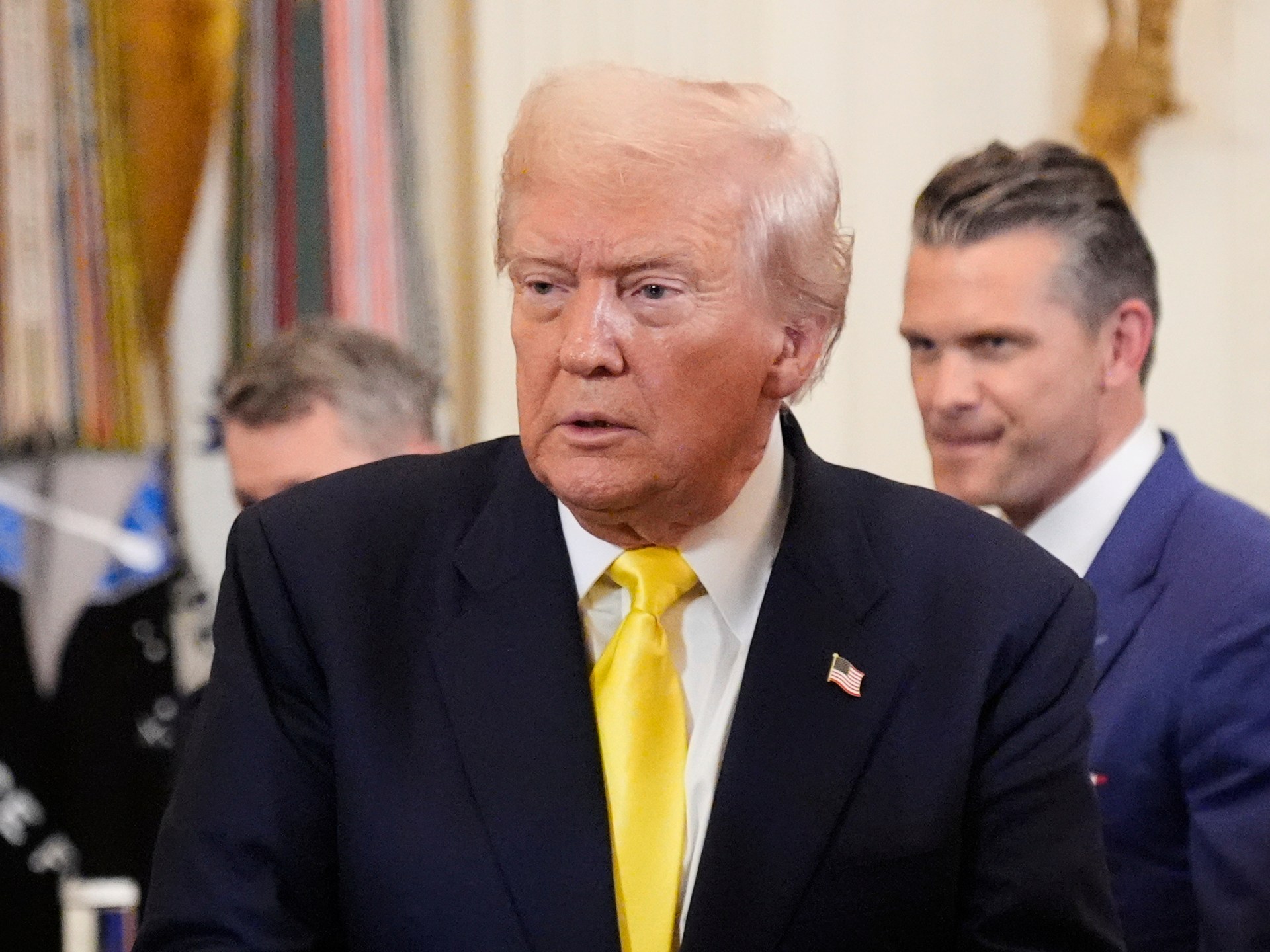
President Donald Trump secretly signed an order ordering soldiers to take action against drug cartels and others criminal groups From Latin America, according to a New York Times report.
On Friday, the newspaper's report appeared to be confirming the statements earlier in the week of Secretary of State Marco Rubio, who reported that the US military had approved to take aggressive measures against the cartels.
“This now allows us to target what they operate and use other elements of American power, intelligence agencies, the Ministry of Defense, whatever … to target these groups if we have the opportunity to do so,” Rubio said on Thursday.
“We have to start treating them as armed terrorist organizations, not just drug trafficking organizations.”
The news, however, stimulated the concern that soldiers can be deployed in the United States and abroad to fight against criminal groups sanctioned like the Sinaloa cartel, Tren of Aragua and Mara Salvatrucha (MS-13).
Trump administration designated Entities such as “foreign terrorist organizations”, putting them in the same category as groups like Al-Qaeda, Isil (Isis) and Boko Haram.
But an official from the United States government, speaking on condition of anonymity, told the reuters news agency that no military action seemed imminent.
Mexico responds to intervention fears
However, during a press conference on Friday morning, Mexican president Claudia Sheinbaum faced questions about the risk of American intervention on her country.
She recognized that her government had received information on the coming order from the Trump administration.
But Sheinbaum denied that the result would be the American army operating on Mexican territory. She pointed out that her country is not likely for American intervention.
“There will be no invasion of Mexico”, ” Sheinbaum said.
“We were informed that this decree was coming and that it had nothing to do with the participation of military staff or an institution in our territory.”
The Mexican chief previously warned that any American military activity on Mexican territory would be a serious violation of the country's sovereignty.
The possibility, however, was raised in the past, especially by politicians on the American right. In 2023, for example, the Governor of Florida, Ron Desantis – then candidate for the presidency – has repeatedly committed to authorizing the use of force against drug cartels on Mexican soil.
Other republican politicians, such as the representative Dan Crenshaw, also proposed legislation at Greenlight Military Action against Cartels.
Such affirmations were welcomed by anger in Mexico, where a long history of American intervention contributed to a strong belief in the need to maintain national sovereignty.
However, in May, Trump confirmed that, earlier this year, he proposed to send us troops to combat drug trafficking in Mexico. For his part, Sheinbaum said that she firmly repelled The idea.
“I said to him:” No, President Trump, our territory is inviolable, our sovereignty is inviolable, our sovereignty is not for sale “, she said at the time.
Vast consequences for the region
Trump's heavy approach also caused frustration in other parts of Latin America, as well as thorny legal and ethical problems.
Since he took office for a second term in January, Trump has repeatedly extended the limits of executive power by affirming that the United States has faced an “invasion” of criminal immigrants, thus authorizing him to take extreme measures.
But legal experts say that it is not clear what the American army could be able to do in the constraints of national and international law.
The Posse Comitatus Act of 1878 prohibits soldiers from being used as a national police force. The local and federal police are therefore the entities that direct operations on domestic soil to disturb and stop the gangs.
International laws, on the other hand, restrict military actions abroad, except in cases of self -defense. The Charter of the United Nations, for example, includes a language which calls for its members to refrain from “threat or the use of force against territorial integrity or political independence of any state”.
Attacking people outside combat situations could also affect international humanitarian law.
Critics have also questioned the effectiveness of adopting such a strong approach to gangs, drug cartels and other groups.
After Trump has appointed many groups such as “terrorist organizations”, human rights groups have pointed out that civilians who live in a territory controlled by gangs could be inadvertently sanctioned, as they are often forced to pay the gangs by coercion.
The reports that Trump has signed the military action authorization is also at a time tense for American US American relations.
The American president recently placed high prices on Brazil, in order to end a trial against his right -wing ally Jair Bolsonaro for his alleged involvement in a coup d'etat.
Brazilian president Luiz Inacio Lula da Silva called Trump's actions “unacceptable” and described them as an effort to interfere in the sovereignty of another country.
