

The United States and China announced they would step up the fight against fentanyl under a new trade deal. But the details are minimal, and it's unclear whether the deal addresses the key issue: the role that synthetic precursor chemicals play in fueling the illicit trade.
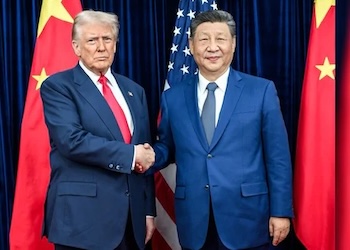
The agreement came after an Oct. 30 meeting between Chinese President Xi Jinping and U.S. President Donald Trump in Busan, South Korea, focused on economic and trade relations. The deal also included a commitment from China to “stop the flow of precursors used to manufacture fentanyl into the United States,” according to a White House fact sheet.
“Specifically, China will stop the shipment of certain designated chemicals to North America and strictly control exports of certain other chemicals to all destinations worldwide,” the fact sheet adds.
SEE ALSO: The Synthetic Silk Road: Tracing the Gray Market Trade of Precursor Chemicals in China
In return, the United States announced it would lower from 20 percent to 10 percent the tariffs it imposed earlier this year on Chinese goods entering the country.
Trump claimed in a social media post following the meeting that this was because China had agreed to “work diligently with us to stop the flow of fentanyl into our country.” He added that the Asian nation would help “end the fentanyl crisis” but did not provide further details.
InSight Crime requested more details, but the State Department referred InSight Crime's request for comment to the White House, and the White House declined to comment beyond the president's public statement.
For its part, the Chinese government did not mention any agreement related to fentanyl in the official report of the meeting between the two leaders. And China's Foreign Ministry did not respond to a request for additional information before publication.
Lack of designer precursors undermines fight against fentanyl
The key issue not addressed in public statements is that of the designers' forerunners. These are chemicals created for a specific purpose, such as the production of illicit synthetic drugs, and are not regulated.
Governments have difficulty controlling them, and when controls are instituted, chemical producers simply change the formula to stay outside the scope of regulations and legal codes.
InSight Crime has seen first-hand how it works. By 2023, for example, independent fentanyl producers in Sinaloa — the epicenter of illicit production in Mexico — said InSight Crime, they were given slightly modified versions of 1-BOC-4-piperidone and 4-piperidone. The International Narcotics Control Board (INCB) then added to its list of controlled chemical substances. About a year later we found it again, this time Chinese precursor suppliers told InSight Crime they were sending modifications of 1-BOC-4-hydroxypiperidine and (2-bromoethyl)benzene in order to avoid international controls.
It's unclear whether these types of issues will be resolved, but, speaking on Fox News, US Treasury Secretary Scott Bessent said the two countries would establish “working groups that over the next few weeks will set out very objective metrics to determine whether” China's engagements are “successful or not.”
SEE ALSO: Brokers: pillars of the flow of precursor chemicals to Mexico
The U.S. government has also been frustrated by the lack of prosecution or sanctions against Chinese producers. For their part, American prosecutors have tried to fill this gap by targeting several chemical precursor brokers in recent years. Most recently, on October 23, Mexican authorities extradited to the United States a Chinese chemical broker who allegedly links maintained with both Sinaloa Cartel and Jalisco Cartel New Generation (Cartel Jalisco Nueva Generación – CJNG).
At the same time, the US Treasury Department has sanctioned several Chinese chemical companies over the years for their alleged role in supplying fentanyl precursors to criminal networks in North America. In a recent case, U.S. prosecutors in the Southern District of Ohio indicted four Chinese chemical companies and more than 20 people, which InSight Crime investigated for a reason. previous report.
China is one of the main suppliers of chemical precursors for the illicit production of fentanyl, but has taken a number of measures in recent years to combat this trade. In July 2025, for example, the government designated a powerful class of synthetic opioids called nitazenes and its analogues as controlled substances, making their production, sale, or trafficking illegal. China also imposed controls on many fentanyl-related substances in 2017 and again in 2019.
Yet trade continued, and Trump sought to exploit the issue for economic advantage, although those efforts may have missed the mark.
“The central problem doesn't seem to be addressed anywhere, which is that most of the precursors today are unlisted chemicals,” said Vanda Felbab-Brown, a researcher at the Brookings Institution and one of the world's foremost experts on the illicit fentanyl trade, referring to synthetic precursors.
This is problematic because of “constant innovations in how to cook fentanyl from unscheduled precursors,” she added.
Additionally, Felbab-Brown said there are a number of blind spots in China's legal code that have helped chemical producers circumvent law enforcement.
“The lack of material support clauses, the absence of racketeering and conspiracy clauses, and the limitations on action against unscheduled precursors have been the big gap in Chinese law enforcement,” Felbab-Brown told InSIght Crime.
“This is the big issue to focus on in the bilateral relationship, whether through confrontational means or through cooperative and innovative means,” she said.
Featured image: US President Donald Trump and Chinese President Xi Jinping meet in South Korea. Credit: Reuters
