

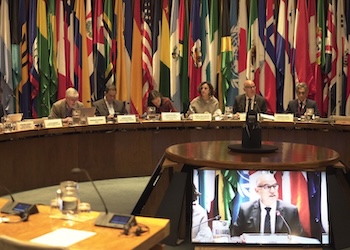
Policies to combat organized crime should pay more attention to the economic effects of illicit activities and seek to attack crime financially, experts argued at a recent conference.
The Economic Commission for Latin America and the Caribbean (Comisión Económica para América Latina y el Caribe – CEPAL) brought together its own experts as well as those from other organizations such as the United Nations Office on Drugs and Crime (UNODC), the World Bank and regional governments at an event in late September.
SEE ALSO: Amid global turmoil, is change underway in the international drug regime?
Participants discussed the impacts of criminal activities on the economies of Latin America and the Caribbean. They argued that while governments frequently invest in security-focused strategies that generate short-term gains, they should also focus on economic policies and long-term outcomes to combat gangs.
Criminal activity as economic output
Illicit economies such as arms and drug trafficking and illegal mining create jobs, move money and generate revenue. As such, seminar participants argued that they are part of a country's economy and should be analyzed as such.
The economic aspect of organized crime is particularly evident in illegal mining areas, where criminal operations support legitimate businesses and spawn new illicit economies. Mine bosses use their illicit income to buy tools and machinery, as well as fuel to power their equipment – some of which can be stolen or smuggled. They also pay workers who spend their wages at local stores and restaurants. Sex trafficking rings often intervene to meet a demand created by young men with an influx of money.
Strengthening local institutions, improving governance and private sector job creation programs could help reduce local populations' dependence on illegal mining by addressing the roots of the problem. Data-driven impact analyzes and intelligence reporting to monitor policy effects could help refine programs to achieve more effective results. Particularly in the Amazon region, multilateral cooperation focused on economic outcomes could also help reduce crime.
SEE ALSO: Peace leaders in Putumayo, Colombia, bet their lives on replacing coca crops
But economic policies are not a miracle solution. They may be misdirected or have unintended consequences. This happened with programs in Colombia aimed at convincing farmers to grow legal crops instead of the coca plants used to produce cocaine, by providing them with economic subsidies and technical assistance.
The initiative was implemented in the Colombian department of Putumayo in 2017 and initially had positive effects. Coca cultivation declined, as did violence. But the programs failed to achieve their goals, as criminal networks violently threatened community leaders who promoted crop replacement. The initiative has also faced funding challenges, corruption and a lack of political will.
Prevention rather than safety?
As countries devote huge percentages of their gross domestic product (GDP) to security-focused efforts in response to gang activity, the ECLAC seminar heard arguments for increased investment in programs that address the underlying social and economic problems that cause crime.
Many governments in the region have adopted policies that make it easier to keep suspected and convicted criminals in prison for extended periods. Not only does this prevent large numbers of people from participating in the formal economy, but it also often leads to prison overcrowding, which can fuel the growth of gangs and make it difficult for authorities to maintain control. Several countries have built or are building new facilities to try to reduce overpopulation. But it might be more effective for governments to focus on preventing incarceration in the first place, rather than investing limited resources to accommodate an ever-growing prison population.
Drug prohibition also has significant economic impacts. Government efforts to reduce the supply of drugs may actually increase the value of illicit products by creating a shortage without reducing demand. The profitability of the trade allows gangs to continue to recruit new members and improve their methods to continue operating. Rather than investing heavily in punitive and repressive drug policies, participants argued for greater investment in health care and education to provide citizens with alternative and legitimate economic pathways to achieve a decent standard of living.
Political challenges, delayed results
One of the biggest challenges of using an economic perspective to combat crime is that change and results will be slow. This poses a political problem for elected officials, whose mandates are often limited and who are under pressure to obtain rapid results.
The seizure of drugs and the arrest of suspects generate visible results in the short term and allow politicians to campaign on concrete successes. Investments in preventative socio-economic programs may not bear fruit in time for the next election cycle.
Moreover, proposals to reduce spending on policing and incarceration risk being criticized as being “soft” on crime. The only alternative to transferring existing resources is to generate new revenues by raising taxes, which implies higher costs for voters.
Additionally, policies that address the socioeconomic roots of crime may focus on the most vulnerable social groups and areas most affected by organized crime, which may be unpopular with the general public. Part of the electorate tends to oppose policies they believe will help communities they see as responsible for organized crime.
Featured image: Analysts gather to discuss the economic impacts of crime in Latin America and the Caribbean at a recent ECLAC seminar. Credit: Marina Cavalari.
