

American authorities declared recent missile strikes against suspected drug ships in the Caribbean – and now in the Peaceful – target “cartels” and “narcoterrorists”. But the reality of these organizations is that they are dispersed networks that resemble most legal global supply chains, making targeted action against them even more difficult.
Unlike a cartel – which, strictly speaking, is a group of producers who use their control over the supply chain to limit competition and set prices in a given market – there is no single organization that controls the supply chain of a drug, from cultivation to street sale.
What exists instead is decentralized networks of suppliers, producers, transporters, brokers and traffickers, each of whom plays a distinct role. These specialists master their segment of the narcotics pipeline, whether producing drugs in remote laboratories, transporting them through jungles or deserts, or smuggling them through container ports to destinations around the world.

To see how this works in practice, look at Colombia, which product the vast majority of the world's cocaine. Farmers in different regions sometimes grow coca, the plant used to make the famous white powder, or cocaine hydrochloride. under threat from criminal groups. These farmers face brokers or independent buyers who buy their coca paste to sell to larger criminal groups.
SEE ALSO: 5 things to know about TrumP's missile strike in the Caribbean
Colombia is a puzzle of criminal groups, the result of decades of fragmentation which began with the fall of Medellin And Cali cartels. The Revolutionary Armed Forces of Colombia (Fuerzas Armadas Revolucionarias de Colombia – FARC) filled the void left by these groups, controlling coca-producing regions and taxing production to finance their war against the Colombian government. But after the FARC demobilized in 2016, this control broke down again, creating the fractured criminal landscape that persists today.
Currently, the three most important players in the supply of cocaine are the Gulf Clana criminal federation born from Colombian right-wing paramilitaries demobilized in the mid-2000s, which controls most of the country's Caribbean coast; the National Liberation Army (Ejército de Liberación Nacional – ELN), the last Marxist guerrilla group in Colombia, which dominates the border with Venezuela And works inside this country also; and FARC dissidents, now demobilized, who recruited new members and spread into areas of the country they previously controlled.
But even these structures are not hierarchical and top-down. Different substructures within these groups control parts of Colombia where coca is grown, often fight for the control of these areas. Often, they pay farmers for their crops and for coca paste – the intermediate product that serves as the base ingredient for cocaine hydrochloride. In some areas, these groups operate their own laboratories and employ locals to process coca paste into cocaine. In others, labs are run by independent producers who pay a “tax” to the dominant criminal group in exchange for permission to operate on its territory.
Colombian criminal groups are typically responsible for moving drugs domestically to departure points or ensuring safe passage for independent traffickers hoping to use their routes for pay. These starting points include the borders with Ecuador And VenezuelaTHE Caribbean coastand the Peaceful. Cocaine leaves Colombia through all its coasts and borders, and several criminal organizations control each of these exits. But once the drugs leave the country, the role of Colombian groups often ends.
SEE ALSO: GameChangers 2024: networks replace cartels in the cocaine trade
These independent traffickers are also not necessarily members of Colombian criminal groups. They are usually part of a large, flexible network of brokers. And they are one of the most crucial links in the supply chain. Brokers are often the ones who figure out how to bribe port officials to slip cocaine onto container ships. They recruit crews for fast boats that make expeditions from the Colombian coast to Central America or Mexico. They can work with several criminal groups to source cocaine from South America and others, many criminal groups also sell cocaine in consumer markets. These are the logistics brains trade, but drugs rarely pass through their hands.
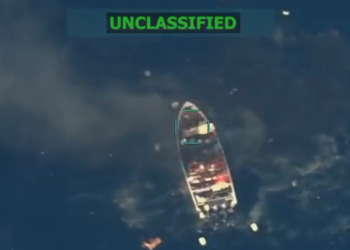
Featured Image: A drone photo of an alleged drug boat. Source: US Secretary of War, Count X by Pete Hesgeth.
