

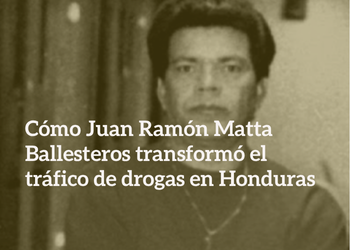
Honduran drug trafficker Juan Ramón Matta Ballesteros died in a U.S. prison at the age of 80, but his drug trafficking legacy lives on. Deputy Director Mike LaSusa and Investigator Sam Woolston discuss his career and lasting influence in the underworld.
Microphone: (00:00:00) Legendary Honduran drug trafficker Juan Ramón Matta Ballesteros has died in a US federal prison. My name is Mike Lasusa, deputy content director for Insight Crime, and I'm here with Sam Woolston, an Insight Crime investigator based in Honduras. Sam, Matta Ballesteros has been out of the game for decades – he spent more than 40 years in prison in the United States – but before that he was an extremely important figure in the cocaine trade. Tell us who he was and how he got his start in the underworld.
Sat : (00:00:29) It's hard to underestimate the importance of Matta Ballesteros to the cocaine underworld, Mike. He's one of the most prolific traffickers in Honduras, and what he's famous for is that he did something really smart: he was one of the first people to connect the big organized crime groups in Mexico, who were very good at moving drugs, with the big organized crime groups in Colombia, who are really good at producing drugs. And Matta Ballesteros in Honduras was exactly in the geographic middle. He had established numerous networks with criminal agents in both countries, so he was the ideal person to make these connections. And that really set the stage for an exponential increase in the quantities of drugs shipped between the two countries and ultimately to the United States, Europe, and other countries as well.
Microphone: (00:01:19) As you mentioned, at the height of his power, his network was responsible for these enormous cocaine flows: by some estimates, up to a third of the cocaine entering the United States was transported through his network. So tell us a little bit more about those geographic advantages and some of the drug trafficking innovations that Matta Ballesteros introduced that helped him get to this point.
Sat : (00:01:42) Absolutely. So, Matta Ballesteros was somehow born in a perfect place, Honduras, which is exactly halfway between North America and South America. So, that was extremely helpful to him. And he transformed Honduras into a sort of logistical hub for cocaine shipments. Before Matta Ballesteros, much of the cocaine was flown in from Colombia. Groups like the Medellín Cartel were infamous for having small Caribbean islands, and they would fly small planes from Colombia and then across the United States to Miami. The problem with airplanes is that there's only a limited amount of cocaine on a plane, and it's also quite an expensive means of transportation, and it's also quite visible.
With Matta Ballesteros, what he did and what started to happen when he was at the height of his power was that large shipments of drugs started being put on boats leaving Colombia, and then they came in and kind of hit Central America, particularly the northern coast of Honduras. Moreover, this method of trafficking is still very common. And from the coast of Honduras, the cocaine would come ashore, and then the traffickers and part of his network would use multimodal drug shipping methods. Thus, he could move on land using mules; they could use another boat; they could use a plane. And really, what stands out is that with this method, you can move a lot of cocaine, and also, it's a very resilient cocaine supply chain. So if one method fails, Matta Ballesteros would be there with another way to transport the drugs.
Microphone: (00:03:13) And he stayed there for quite a long time. He worked through most of the 1980s. Eventually, he was arrested in 1988 and sentenced to prison in 1990, then spent decades in a U.S. federal prison. And in the months before his death, a U.S. federal judge granted him compassionate release, saying the health problems he suffered were very serious and he should be allowed to die outside of prison. The government appealed and overturned the decision, forcing him to remain in prison until his death. And I spoke with his lawyer a few weeks ago, and he told me that the government was really interested in keeping Matta Ballesteros behind bars until he died because of his connection to this really infamous murder of a DEA agent in the 1980s. Can you tell us a little bit about this case?
Sat : (00:04:06) Absolutely. So, Juan Matta Ballesteros, one of the most famous things about him, and what's really well known today, is his alleged involvement in the murder of a DEA agent in Mexico, Enrique Kiki Camarena, who was murdered by agents of the Guadalajara cartel. It was 1985, and it was a real turning point for the United States. Because of this murder, they began to take much more forceful action against the suspected leaders of various criminal organizations. It was a transformative moment. And one of the people suspected of being involved was Matta Ballesteros, although they were never able to prove it in court. He was never convicted. I think they found a hair that they believe belonged to her on the property where Kiki was tortured and eventually killed. And I think there were also hotel records that suggested he may have been in the area at the time of the murder, but the evidence wasn't strong enough to convict him. So even though that's probably the reason he's most famous, the reason Matta Ballesteros is so well known, it's not a crime that they could ultimately convict him of. Although it doesn't surprise me that the US authorities want him to stay in a prison cell.
Microphone: (00:05:21) And as you say, the evidence linking him to the Camarena murder was pretty thin, but there is significant evidence that he was involved in all sorts of other deadly violence during his reign as crime boss. So it's not like we're talking about someone who was necessarily wrongfully imprisoned, and as you said, he wasn't convicted in this case. But it's clear that he's someone who leaves behind a very important legacy in terms of organized crime in Central America. That being said, his arrest did not end trafficking through the region. Tell us a little about how things evolved after his capture.
Sat : (00:06:00) Since the capture of Matta Ballesteros, cocaine flows have only increased. We have a production boom in Colombia. When Matta was there, they were producing maybe, I don't know, a few hundred tons. Today, it is more than 2,000 tonnes. You also have a consumption boom, right? Supply meets demand. In reality, cocaine flows through Honduras are simply greater than ever. Readers are probably familiar with our cocaine raid every year we publish: Last year, Honduras seized a record amount of cocaine. Authorities still say the high number of seizures means they are doing an excellent job in combating these criminal groups. But we find that the same trafficking methods that were pioneered by moving cocaine by speedboats from Colombia to the coast of Honduras are a constant. The reason traffickers use it all the time is because it's very profitable. Despite high seizures, enough cocaine is passing through to make it a really interesting method, even though it's 50 years old.
Thus, cocaine has just grown in Honduras, despite the arrest of Matta Ballesteros in the 1980s, and the country continues to have new kingpins. Those who follow media coverage of Honduras are no doubt familiar with Juan Orlando Hernández, the former president who was allegedly part of a large drug trafficking ring with his family, and his brother, Tony Hernández, is in prison and Juan Orlando is sentenced to 45 years. Juan Orlando Hernández was said to have transformed Honduras into a narco-state. But what we see and what his legacy tells us is that Honduras has always had massive corruption due to drug trafficking networks. These networks have always benefited from impunity. And despite the arrest of kingpins Matta Ballesteros and Juan Orlando Hernández, drug trafficking continues.
Microphone: (00:07:58) Absolutely. And that's why we continue to follow Honduras so closely. Thanks, Sam, that was a really interesting conversation. And if you would like to learn more about Juan Ramón Matta Ballesteros and organized crime in Honduras, please see our coverage at insightcrime.org. THANKS.
Sat : (00:08:15) Thanks, Mike.
