

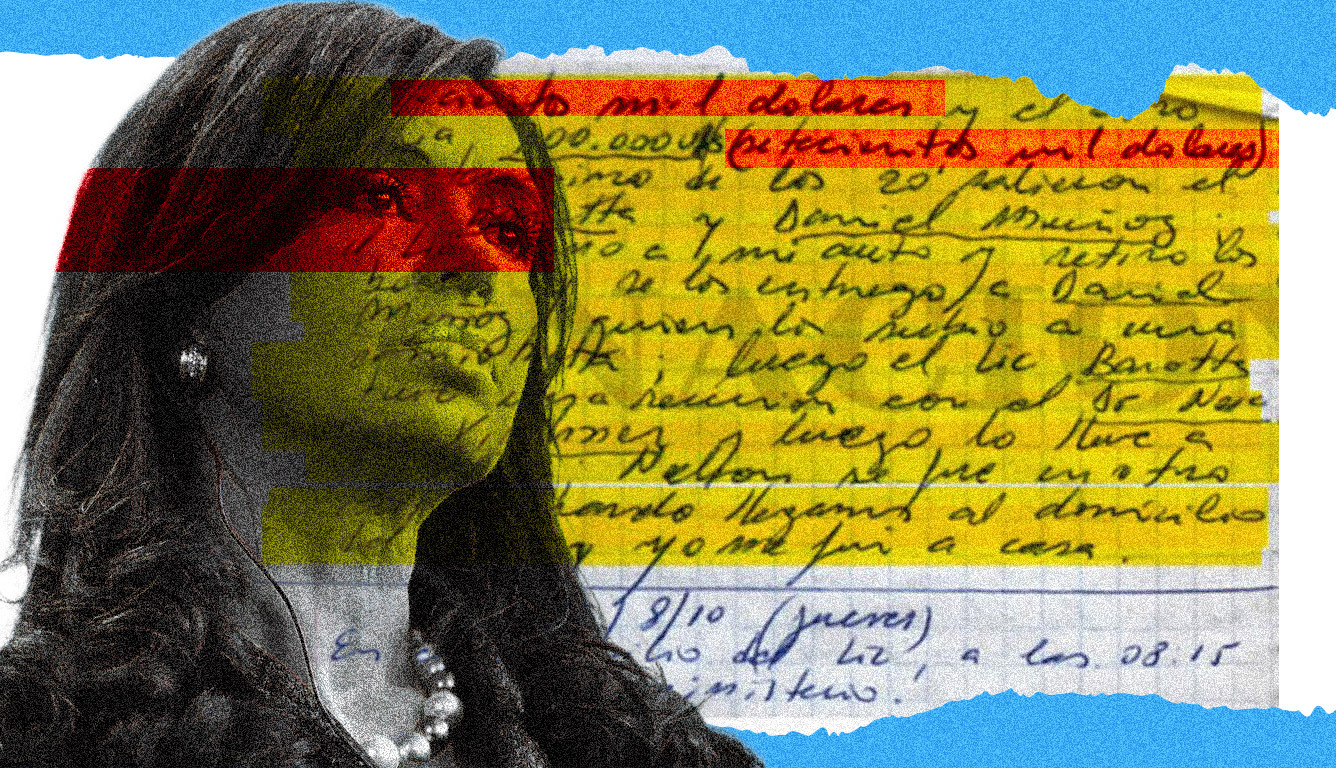
The largest corruption case in Argentine history, known as the “Bribery Books” (“Cuadernos de las Coimas”) affair, began its public trial on November 6. The investigation targeted prominent political and economic figures who allegedly participated in a large-scale corruption scheme between 2003 and 2015, led by former President Cristina Fernández de Kirchner.
How did the affair start?
The affair broke out in 2018, when handwritten notebooks of Oscar Centeno – former driver of Roberto Baratta, right-hand man of the Minister of Planning at the time, Julio De Vido – were leaked to the press. In it, Centeno described in detail how business executives bribed officials during the Kirchner administrations in exchange for public works contracts and concessions.
Who is involved?
Centeno's eight notebooks outline allegations of bribery scheme modus operandithrough his daily record of the trips he made for the Ministry of Planning for more than a decade. He detailed the routes, times, names, companies and even the weight of the supposed bags of cash.
In one of the most broadcast extracts in local media, Centeno mentions Fernández de Kirchner at the top of the pyramid and writes: “In a meeting between Minister De Vido, Baratta and President Cristina F. de Kirchner, … she asked them to continue collecting from companies for the next electoral campaigns.
According to the investigation, below the former president were De Vido — allegedly responsible for organizing the operation — and Baratta, who allegedly coordinated the delivery of money from some of Argentina's most powerful businessmen, with the help of former Public Works officials Nelson Lazarte and José López.
The sprawling affair involves nearly a hundred former civil servants and executives. It progressed largely thanks to the testimony of more than twenty defendants who became prosecution witnesses under the Argentine regime.Law of Repentance“, which reduces sentences for those who cooperate with justice. Their statements and evidence strengthened the investigation.
SEE ALSO: Notebooks and plea agreements: new weapons against corruption in Argentina?
Among those who confessed Héctor Alberto Zabaleta, former Techint executive, participated in the contract corruption network; Ángel Calcaterra, cousin of former President Mauricio Macri and former owner of the construction company Iecsa; Juan Carlos De Goycoechea, former director of the Spanish construction company Isolux in Argentina; Claudio Uberti, former civil servant of the Ministry of Planning; José López, former Secretary of Public Works; and Víctor Fabián Gutiérrez, former private secretary of Fernández de Kirchner.
What are the fees?
The trial covers 304 acts of corruption falling under six criminal categories: illicit association, concealment, giving and receiving illegal gratifications and active and passive corruption. According to prosecutor Carlos Stornelli and the late judge Claudio Bonadio, the total amount collected in bribes could exceed $200 million.
In their statements, the cooperating defendants detailed how the program worked and the benefits they received. Miguel Aznar, former president of construction and engineering company Decavial SA, admitted paying bribes to obtain contracts and road concessions in 2003.
Aldo Roggio, former president of Grupo Roggio — which controls Metrovías SA, operator of the Buenos Aires metro and the Urquiza railway — said he must return 5% of the transport subsidies his company received.
Carlos Wagner, former president of the construction and engineering company Esuco and the Argentine Chamber of Construction (CAC), also confessed and an undeclared Swiss account with $20 million frozen.

What irregularities surround the case?
The main irregularity is that the case started without the original notebooks. Centeno's eight notebooks were neither seized by court order nor handed over directly by him.
Journalist Diego Cabot, who said he received the notebooks from Jorge Bacigalupo, a friend of Centeno, handed copies to prosecutor Carlos Stornelli in April 2018, marking the start of the case.
Stornelli then forwarded the copies to Judge Claudio Bonadio, who took over the investigation. In Argentina, the judges assigned to each case are generally selected by lot drawn by the Federal Chamber once the complaint is filed. The fact that the documents went through Stornelli, rather than directly through the judge, raised questions about the legality of how the case began. Additionally, Stornelli's involvement sparked controversy given his reputation: although he was never formally charged, he was accused of bias in several of his cases.
When the judge asked Cabot for the original notebooks, he said he no longer had them and Centeno claimed he burned them. Later, six of the eight reappeared in Cabot's possession, allegedly delivered by an anonymous source.
A forensic report by the National Gendarmerie confirmed that Centeno was indeed the author but determined that there were approximately 1,500 alterations, including overwrites, erasures, correction fluid, abrasive or chemical deletions and insertions.
How did the main defendants react?
In September 2025, before the trial, nearly 50 business executives charged in the case offered more than $13 million in “global reparations for damages,” a legal mechanism under Argentina's penal code that allows financial compensation in exchange for dismissal of charges — but the offer was rejected.
Prosecutor Fabiana León argued that accepting such payments would have meant “opening a market for impunity” and weakening state accountability.
If convicted, the executives face one to six years in prison, fines equal to or greater than the bribes paid, asset seizures and a ban on participating in public procurement or tenders for at least 10 years.
Cristina Fernández de Kirchner's lawyer, Gregorio Dalbón, argued that, as in the “Vialidad case” – for which the former president is under house arrest – this is “political persecution” and that “the verdict is already written.”
Fernández de Kirchner has already been charged in ten cases, five of which have gone to trial. If convicted in the Bribe Books case, she faces between five and 18 years in prison.
What does this affair reveal about organized crime?
The Bribe Books trial reveals Argentina's deep vulnerability to systemic corruption in public tenders and contracts that tie high-level politicians and businessmen to dynamics typical of organized crime.
In this network, corruption functions like a criminal economy, with hierarchies, intermediaries and financial flows comparable to other illicit activities that depend on networks with privileged access to the state apparatus.
SEE ALSO: Details emerge on Argentina's 'Dinero K' corruption scheme
But high-level corruption scandals in Argentina are not new. Other former presidents, such as Carlos Saúl Menem and Fernando De la Rúa, have been investigated, but none have faced a public trial of this magnitude.
Whatever the outcome, the case shows how porous the boundary between politics and criminality remains and how mechanisms of state capture continue to operate in the same logic of impunity as that observed elsewhere in Latin America.
The high level Odebrecht affair — a network of corporate corruption that operated in at least twelve Latin American countries to obtain public contracts — and the “State co-optation» The case, which implicated former President Otto Pérez Molina for allegedly favoring companies that illegally financed his campaign, are just two examples of a larger, deeper problem.
