

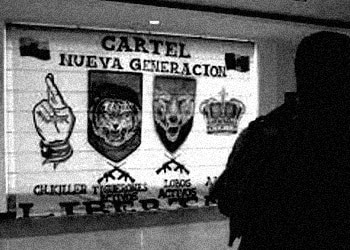
In just a few years, the Lobos have grown from a splinter group of the Choneros to one of Ecuador's most powerful and innovative criminal organizations, with thousands of members spread across the country and in prisons.
Special series: Behind bars, out of control: the fall of Ecuador's prisons and the rise of the mafias
Read our latest investigation into how a crisis in Ecuador's prisons escalated into brutal violence, criminal chaos and a national security crisis.

Born in Ecuadorian penitentiaries, the Lobos first emerged as an independent criminal group in 2021, when they led a breakaway coalition of gangs that waged war against Ecuador's most powerful criminal group, the Choneros. Since then, they have seized territory across the country, become key partners of transnational drug traffickers, were the first to become involved in Ecuador's gold industry, and have established themselves as the dominant criminal actor in the Ecuadorian capital, Quito.
History
The roots of the Lobos go back to the meeting between bank robber Wilmer Chavarría Barré, aka “Pipo”, and Jorge Luis Zambrano, aka “Rasquiña” or “JL”, the now deceased charismatic leader of the Choneros gang. The two men met in the prisons, where Rasquiña recruited Pipo into the Choneros gang, which he was rebuilding and reforming. In exchange for joining the Choneros network, Rasquiña allowed Pipo to retain command of his own structure operating under the aegis of the Choneros. This structure would take the name Lobos.
After Rasquiña's murder in December 2020, the Lobos would lead a splinter coalition of former Choneros factions in a criminal conflict against Rasquiña's successor, José Adolfo Macias Villamar, aka “Fito.” This alliance, which included the Chone Killers and the Tigueronscollectively called Nueva Generación (New Generation).
New Generation was financed and supported by Ecuadorian drug traffickers, notably Leandro Norero. And they established ties with the Cartel Jalisco Nueva Generación of Mexico (Cartel Jalisco Nueva Generación – CJNG), which at the time challenged the near-monopoly previously enjoyed by the Sinaloa Cartel on trafficking routes passing through Ecuador to Mexico and Central America.
The conflict between the Lobos alliance and the Choneros erupted in early 2021 when a failed attack on Fito led to two days of violence in the country's prisons that left 79 people dead. In the years that followed, rival networks vied for power in prisons and on the streets, sparking a spiral of violence.
But in 2022, the New Generation alliance was starting to fray. When the R7 gang split from the Lobos, it led to a series of massacres at multiple prisons that killed at least 94 people. In October 2022, the Lobos also murdered Norero in a prison massacre, in what police intelligence believed to be retaliation for his negotiations with the Choneros. While the Tiguerones and Chone Killers eventually realigned with the Choneros, the Lobos continued to oppose them.
At the same time, the Lobos would be behind much of the political violence that would destabilize the country. This situation came to a head in August 2023, when an anti-corruption presidential candidate, Fernando Villavicencio, was assassinated during a campaign rally. Even though the alleged killers, who were later murdered in prison themselves, were Colombian, prosecutors believe the Lobos were behind the assassination.
Throughout this period, the Lobos also grew exponentially, seizing territory and building networks in strategic areas across the country. In each of these areas, they have formed local gang networks, which finance themselves through extortion, microtrafficking, kidnappings, thefts and other predatory crimes.
Within a few years, the Lobos established a presence in key drug trafficking areas, which they used to establish themselves as providers of logistics and security services for transnational drug trafficking operations. They have also settled in gold mining regions, where they extort and co-opt legal and illegal mining operations. And they set up shop in Quito, seizing the capital's wealth of criminal opportunities and cementing their position as one of, if not the most powerful criminal networks in Ecuador today.
In early 2024, a military intervention in the prison system isolated several senior Lobos leaders and disrupted communications between the group's external network and prison commanders. While this does not appear to have done much to stop Lobos' activities externally, it may have affected the group's unity, with reports of splinter factions emerging in important areas such as Manabí and Machala.
Direction
In 2021, it was reported that Pipo was killed during a riot in Turi Prison. However, Ecuadorian authorities later said they believed his death was staged to facilitate his escape and that he remained leader of the Lobos. This was validated when Pipo was captured in Spain end of 2025. It is still unclear who will take command of the Lobos after his capture.

Alongside Pipo, there is a group of senior Lobos leaders, some of whom are still in prison and others at large. Among them are Ángel Esteban Aguilar Morales, alias “Lobo Menor,” Álvaro Montaño Valencia, alias “Palanqueta,” and Fabricio Colón Pico, alias “Capitán Pico.”
Geography
According to information provided by the Defense Ministry and former intelligence officials, as of early 2024, the Lobos were present in 16 of Ecuador's 24 provinces. This includes drug trafficking regions of the Pacific coast, such as the cities of Guayaquil, Machala and Esmeraldas. Since the beginning of 2024, they have also made incursions into Manabí, the historic stronghold of their main rivals, the Choneros. In addition, they expanded to provinces where gold mining was established, including Imbabura, Sucumbíos, Azuay and El Oro, as well as to the capital Quito.
Before the military intervention in early 2024, the Lobos had transformed the prisons of Latacunga in Cotopaxi and Turi in Cuenca into strongholds and criminal command centers. They also took over several smaller prisons across the country, including La Inca prison in Quito, and sections of Ecuador's largest prison, Litoral, in Guayaquil.
Allies and enemies
The Lobos have been at the center of two major criminal realignments that have shaped the Ecuadorian underworld since 2020. First, they played a leading role in the formation of the New Generation, a breakaway coalition. Later, when their coalition partners sought to rebuild their ties with the Choneros, the Lobos declared war on their former allies.
According to U.S. and Ecuadorian authorities, the Lobos are a central trafficking partner of the Mexican CJNG. Their control over access to several major ports means they likely also work with European drug traffickers, among whom Albanian networks are the most active. According to some media reports, the Lobos also maintain relations with dissident factions of the demobilized Revolutionary Armed Forces of Colombia (Fuerzas Armadas Revolucionarias de Colombia – FARC), which control the supply of cocaine in the border region between Colombia and Ecuador. However, the extent of these links remains unclear.
Outlook
In its 2024 decision to sanction the Lobos, the U.S. Treasury Department's Office of Foreign Assets Control (OFAC) said the group was Ecuador's largest drug trafficking organization. And although they remain at the operational level of drug trafficking, acting as service providers rather than trafficking their own shipments, this designation is an indication of how quickly the group has grown and how firmly it has established itself.
If the military intervention in prisons and on the streets in early 2024 disrupted Ecuador's criminal dynamics, the Lobos seem less affected than some of their rivals, continuing their advance in strategic territories like Esmeraldas and Manabí. However, the emergence of what appear to be splinter groups in some areas suggests that the Lobos may also be affected by the increasing atomization of Ecuador's criminal groups. Pipo's capture could speed up this process.
