

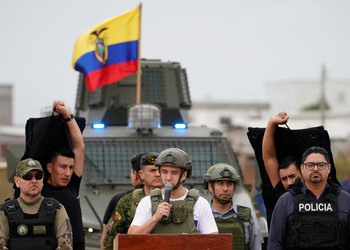
The Ecuadorian government celebrated its two years in office by touting the results of its tough crime-fighting policies. But his claims of progress do not present a clear picture of the country's security realities.
Ecuadorian President Daniel Noboa took office two years ago on November 23, as Ecuador faced the worst security crisis in its history, fueled by the rise of powerful organized crime groups like the Choneros, LobosAnd Tiguerons. The president responded to the rise in crime by calling these groups “terrorists” and mobilizing the military to intervene.
Referencing this two-year milestone, Ecuador's Interior Ministry released a series of infographics on its
Extortion infographic shows that security forces carried out 1,134 operations against extortion networks during Noboa's two years of existence, resulting in 2,858 arrests and the seizure of $9.9 million.
The chart compares these figures to figures from November 2023, when only 160 operations against extortionists resulted in 329 arrests and the seizure of $3 million. There is, however, no indication of the period to which the 2023 figures refer.
👮 𝐋𝐔𝐂𝐇𝐀 𝐂𝐎𝐍𝐓𝐑𝐀 𝐋𝐀 𝐄𝐗𝐓𝐎𝐑𝐒𝐈Ó𝐍
During a few years of management, together with the head of the national government, we executed 1,134 agents against extortion and arrested 2,858 people involved in this crime.
The State responds with more force to guarantee… pic.twitter.com/qp2AP3Ozvc
– Ministry of Interior of Ecuador 🇪🇨 (@MinInteriorEc) November 24, 2025
Additionally, the metric of police operations to measure extortion cited in the ministry's message says little about true crime levels. Police statistics shared with InSight Crime show that reports of extortion increased from 13,627 in 2023 to 14,579 in 2024, before falling to 5,314 in the first nine months of 2025.
There is a similar problem with drug trafficking infographicwhich compares 513 tons of seizures under the Noboa administration with 221 tons in November 2023. The date range is once again unclear, making the comparison impossible.
At the same time, our own reports show that cocaine seizures have jumped 195 tonnes in 2023 has 252 tonnes in 2024. Although full data for 2025 is not yet available, the government has said that seizures are about to break up the 2024 record.
“The State is responding with greater force to guarantee the security of all Ecuadorians. The figures demonstrate it,” the message reads.
But the latest numbers are fuzzy at best and misleading at worst. Without a clear time frame for 2023 data, it is impossible to make a direct comparison with the Noboa administration's numbers, and its claims cloud the understanding of security gains and losses.

The Home Office did not respond to InSight Crime's requests for clarification on the statistics at the time of publication.
Homicide is conspicuously absent from the statistics presented by the Interior Ministry. Noboa took office at the end of the most violent year in Ecuador's history, during which the country experienced a horrific 47 homicides per 100,000 inhabitantscompared to just 6 per 100,000 in 2018. After a slight decline in 2024, homicides are on the rise again, with Ecuador on track to record a homicide rate of more than 50 per 100,000 in 2025.
In the prison system, which has long been a logistics hub and cash cow For Ecuadorian gangs, violent deaths remain high. Three prison massacres resulting from gang conflicts have left more than 60 people dead in three separate events since September, although Noboa has made government control of prisons a key pillar of its security policy.
The pivot strategy
President Noboa's emphasis on security force operations and international collaboration has placed significant pressure on the leadership structures of Ecuador's criminal groups. But rather than dismantling organized crime, these dismantlings served to reshuffle the criminal scene.
The pressure led to the capture of its most notorious leaders, notably Tiguerones. William Alcivar Bautista, aka “Willy” in October 2024; Chief of the Choneros Adolfo Macías Villamar, aka “Fito” in June; and the leader of the Lobos Wilmer Chavarría, aka “Pipo” on November 16. Security forces also captured dozens of regional and local gang commanders.
SEE ALSO: Ecuador Country Profile
But when a leader is removed from office, various factions once loyal to that leader fight to conquer territories and fill leadership voids. In one example from March, a faction of the Tiguerones of Guayaquil, the Fénix, attacked another faction called the Igualitos, leaving at least 22 dead. The massacre, police told InSight Crime, was due to disputes within the group over who would take command after Willy was captured. Across the country, similar cycles of retaliation persist, and without overall plan To mitigate conflict between local gangs and dismantle criminal infrastructure, violence and insecurity will likely continue at a high rate.
Ultimately, the government must address the deeper question of why people turn to organized crime, according to a Guayaquil social leader who works with young people living in gang neighborhoods and who asked to remain anonymous for security reasons.
“There are no parks, no vocational programs, no cultural activities, nothing,” the leader told InSight Crime in April. “When the state withdraws, the mafias move in. »
