

Extortion increases, the killings of contracts are increasing, illegal mining is booming and the legislators in Peru aggravate things by adopting reforms that promote impunity, according to a new report.
In recent years, Peru has seen a drastic increased crime. Homicides increased by 137% between 2018 and 2024, extortion climbed 370% between 2021 and 2023 and illegal gold exports reached Recording numbers.
But the conclusions of the last of Human Rights Watch report Suggesting the security crisis in Peru is also political, motivated by a congress which actively allows impunity while focusing on institutional checks.
More than half of federal legislators are under a criminal investigation, and accusations of corruption and crime have been increasingly armed for political ends in recent years, contributing to significant political instability. This gave legislators an incentive to weaken the capacities to combat state crime in order to protect their personal and political interests.
See also: More victims are looking for police aid for increasing extortion in Peru
Below, we describe three ways in which Peruvian legislators undermine the fight against organized crime, according to the organization of human rights.
The Peru Congress recently adopted a series of laws that strip prosecutors and tools in the tools to combat crime.
In May 2023, the statutes were reduced to one year, which prompted dismissals during time constraints, including one involving the then president of the congress. The following month, legislators limited the use of cooperative witnesses and demanded testimonies recorded on video – changes that discouraged the cooperation of initiates.
In July 2024, the Congress then asked the defense lawyers to be present during the search mandates, limiting the element of surprise and allowing suspects to destroy evidence or to flee. Likewise, in April, a new rule prohibited the confiscation of assets until conviction, giving criminals time to hide the badly acquired wealth for long trials.
The new laws have aggravated the operational gaps in a system already dealing with the constraints of resources and heavy workloads, said Christian Campos Vásquez, research partner at the Institute of Criminology and Studies of Violence (Instituto de Criminología y Subrencia – ICEV) in Peru.
“Before the reforms of recent years, we had a police, justice and prosecution system which operated with rare resources, limited budgets and a heavy load of files.”
Political interference in the judiciary
The legislators have dismantled judicial independence, transforming surveillance organizations into politically compromised entities by appointing judges of the constitutional courts through opaque processes and by pushing bills which allow the congress to sanction or withdraw judges and prosecutors without regular procedure.
In particular, in March 2024, the Congress ounted two members of the National Council of Justice in the midst of an investigation influenced against the general of the time, the general of Patricia Benavides. Benavids had previously made a meticulous exam for rejected the prosecutor investigating his sister, who is a judge, Emma Benavids, for having allegedly taken bribes to release drug traffickers. Affairs involving corruption and elites are now less likely to continue because legal officials are discouraged to continue them.
The aggression of the congress against judicial independence is not only opportunism, but a response to the exceeding perceived by the judicial authorities, Andrés Romaña, Peruvian political analyst, explains. He quotes long -term surveys that have imposed severe measures on individuals without convictions, such as former President Pedro Pablo Kuczynski, under investigation for alleged Odebrecht links for more than a decade. Despite no conviction to date, his houses have been seized and he was excluded to see his wife or leave the country.
“According to the law, you are innocent until it is proven the opposite. But in recent years, it has seemed more to have changed for, you are guilty until the opposite is confirmed,” Romaña told Insight Crime.
Undermine transparency
The congress has also advanced a wave of legislation which restricts independent surveillance.
In April, for example, he adopted an “anti-Zo” bill, justified as improving transparency in organizations funded abroad. In practice, it prohibits NGOs from using international funds for legal action against the State, such as prosecution of rights violations, environmental misdeeds or constitutional allegations. Violations can cause fines or steep suspension, stifling the basic advocacy work.
Simultaneously, the Congress pushes bills to expand defamation laws and require withdrawal within 24 hours of receipt of an opinion – a move from criticism dissuades investigation journalism. Romaña notes that in a system where trials are getting longer for years, the simple fact of being prosecuted acts as a punishment, emptying the resources of journalists thanks to expensive legal proceedings, whatever the result. The criminalization of independent media removes critical control of government power, facilitating uncontrolled authority.
The Congress also refused to ratify the ESCAZú agreement, a regional treaty which provides public access to environmental information and justice. The refusal weakens the protections against illegal forest exploitation and mining, the most urgent environmental crimes in Peru.
See also: 6 illegal economies threatening the ecosystems of Latin America
The HRW report offers a range of recommendations to cope with the dynamics presented above, in particular by urging the congress to reject the laws that expand its power over the judiciary and by calling on prosecutors to investigate the links of managers with organized crime. But these guidelines feel aside from the institutional realities that the report itself describes.
Romaña is appropriate that deeper reforms of the magistracy and the prosecutor's office are necessary, but warns: “Congress is too illegitimate to undertake a reform of this magnitude.”
Experts agree that responsibility may be more likely to come from the electorate. The 2026 elections approaching better informed citizens could be the best bet of Peru in the objective of a more transparent and responsible government.
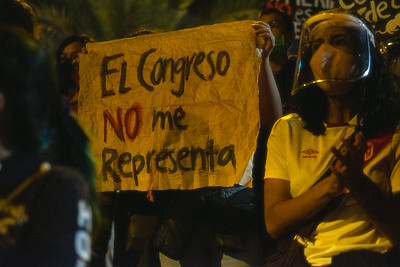
Star image: anti-government protests in Miraflores, Lima, Peru. Credit: Samantha Hare, Flickr (Creative Commons license).
