

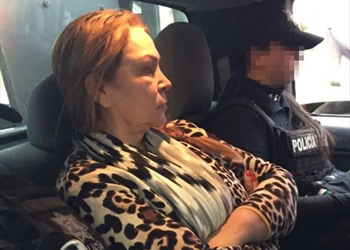
When Guadalupe Fernández Valencia, aka “La Patrona,” was photographed sitting in the back of a police car after her 2016 arrest in Culiacan, Mexico, her expression gave nothing away.
Wearing a leopard-print cardigan, arms crossed, hair loosely braided, the sixty-year-old's expression was flat. She looked less like a kingpin arrested on international drug trafficking charges and more like an annoyed woman. abuela wait in traffic.
Perhaps her apparent nonchalance was part of the reason she had made it this far into one of the most powerful trafficking rings in the Western Hemisphere.
As U.S. prosecutors began closing in on the Sinaloa cartel's inner circle in the late 2010s, Fernández Valencia emerged as the intersection of two of the cartel's most critical flows: narcotics heading north and cash heading south.
For years, Fernández Valencia was a key architect in overseeing the flow of cocaine, heroin, methamphetamine and marijuana into the United States – and millions of dollars into Mexico. Prosecutors said she was the equivalent of the Sinaloa Cartel's chief financial officer and the right-hand man of Jesús Alfredo Guzmán Salazar, aka “Alfredo,” one of El Chapo's sons and a founding figure in the cartel's Chapitos faction.
A seat at Sinaloa's most powerful table required trust and placed her unusually high in the ranks of a criminal organization long dominated by men. She was arrested a month after Joaquín “El Chapo” Guzmán, based on the same indictment that would ultimately send her to life in prison.
But his origins in drug trafficking were humble.
After moving from her home state of Michoacan to California in the 1990s, she was convicted of street drug dealing. Those charges landed her a decade behind bars in California before she was deported to Mexico in 2007.
His return to Mexico opened a new chapter in his trafficking.
SEE ALSO: Sinaloa Cartel Profile
She moved to Culiacán, the capital of Sinaloa state and the headquarters of El Chapo's network, and connected with her brother Manuel, who was already embedded in the cartel. The California contacts she made on street corners now became an asset for transnational drug trafficking and money laundering.
But when Manuel was arrested in 2010, she stopped her trafficking activities, moved her family to Guadalajara and waited, according to court documents.
Two years later, she returned to Culiacán and, over the next decade, transitioned from drug trafficker to illicit financier. Drug proceeds collected in Los Angeles were funneled through exchange offices in Guadalajara to Mexico.
Bulk cash, structured bank deposits, wire transfers and alternative credit systems were all part of its anti-money laundering playbook.
Fernandez Valencia's rise resulted in a direct relationship with Alfredillo, whose operations she helped oversee as his chief lieutenant, from sourcing to delivery. She pleaded guilty in a Chicago court in 2019.
At his sentencing, a federal judge noted that his cooperation with prosecutors put his life and the lives of his five children in danger. She was released in 2023 after serving about three years of a 10-year sentence.
The whereabouts of Fernandez Valencia are currently unknown.
Featured image: Guadalupe Fernández Valencia after his capture in Mexico in 2016. Credit: Mexican Police.
